Iron Med Rx
A clearer route from product information to care
I scoped and delivered three product journeys, working with the founders and a physician reviewer on information hierarchy, answer search, clinical review, and intake measurement.
The problem and my responsibility
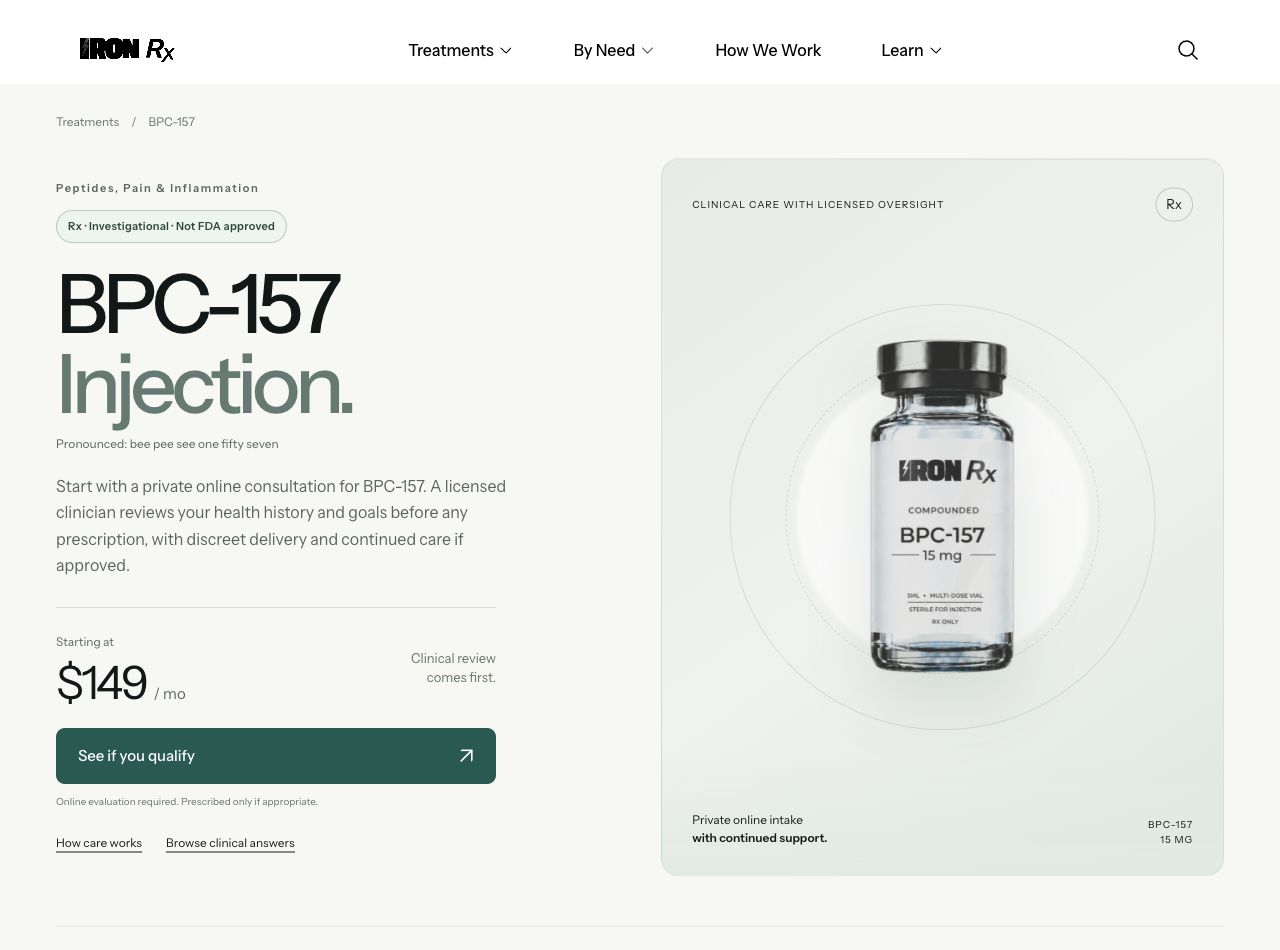
Iron Med Rx wanted product-specific discovery and a clearer route into care. The work covered BPC-157, CJC/Ipamorelin, and Wolverine, with clinical source material and approval owned by a physician.
Product information, repeated sections, research, and calls to action lacked a clear relationship. Visitors needed to understand the offer without having to read a research article first.
What I owned
- Discovery, scope, priorities, UX, and acceptance criteria
- Framer implementation, shared components, SEO/GEO readiness, and instrumentation
- Clinical-review coordination, quality checks, performance evidence, and stakeholder handover
Users, constraints and success criteria
Visitors arriving with a specific product in mind. The working hypothesis came from site inspection, search observations, and stakeholder feedback, not a formal user-interview study.
More qualified visitors starting and completing the appropriate secure intake. Page-side events could support this measurement, but downstream verification remained necessary.
Clinical accountability
Implemented content, verified company facts, and physician approval needed separate owners and states.
Existing platform
The trial needed to fit the existing Framer project, CMS, and collaboration workflow.
Measurement boundaries
Production release, analytics access, and intake/CRM verification were dependencies for proving business impact.
The decisions that shaped the product
Separate decision and research journeys
Each page explained the offer and care process, resolved practical questions, and provided a clear gateway to research without hiding material clinical information.
Improve Framer instead of migrating
Shared React/TypeScript components and CMS structures addressed the gaps without introducing a separate Next.js rebuild.
Handle unanswered questions honestly
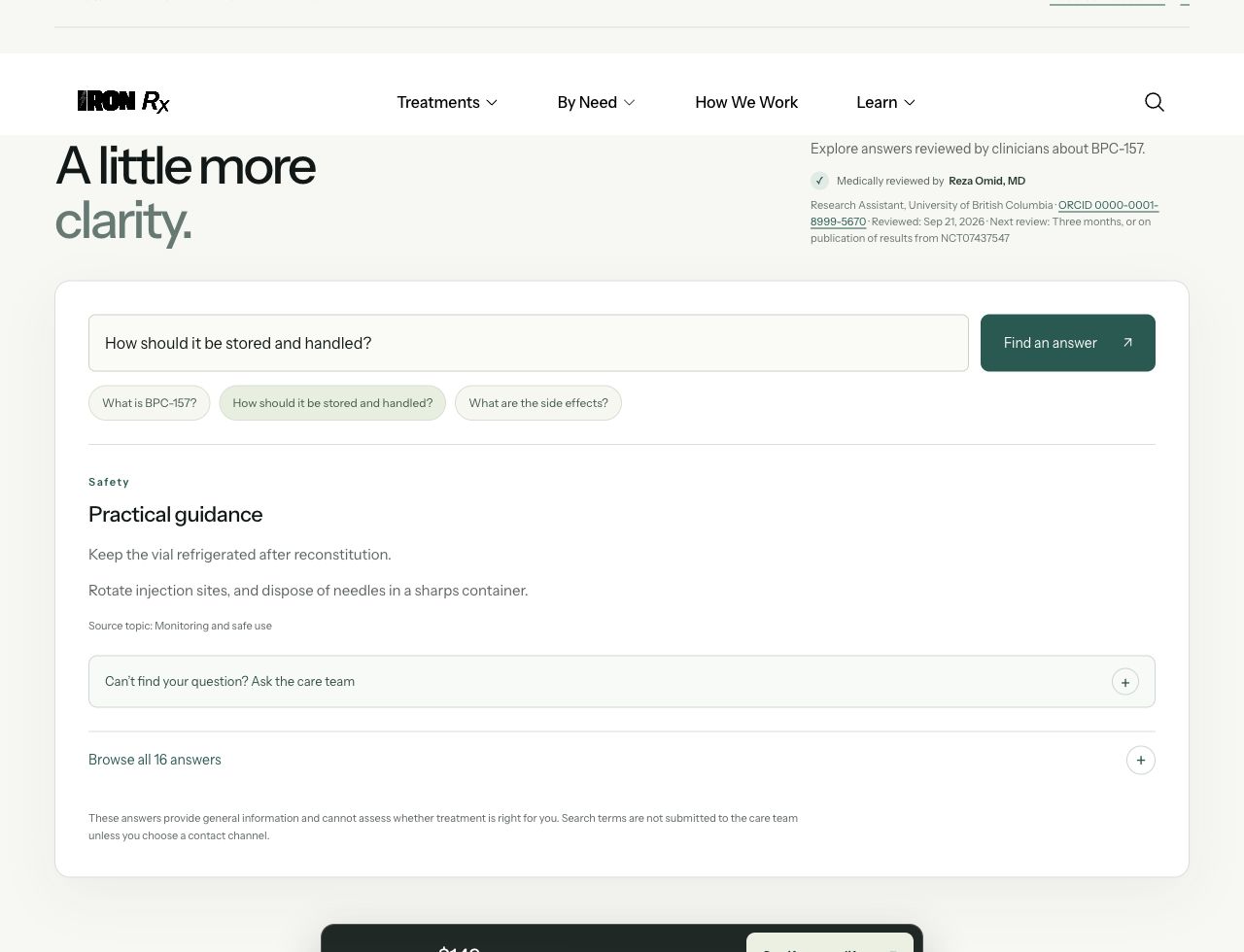
Keyword search, browsing, and a no-answer fallback connected general questions to human support. Personal clinical questions went to secure intake, not general analytics.
From decisions to delivery
Bound the problem
I translated a broad SEO/GEO brief into three product journeys, acceptance criteria, and a funnel measurement plan.
Prove one pattern
BPC-157 was the reference experience. Shared components and product-specific CMS content then supported the other two products.
Review and verify
Jira separated technical delivery, medical drafting, clinical approval, and founder-supplied operational facts. I retained dated implementation and QA evidence.
System and integration detail
Content and components
Product-specific CMS data, reusable Framer components, three research pages, and 47 searchable answers.
Measurement
Page-side hooks cover CTA clicks, research, answer interactions, and contact selection, with campaign passthrough. Raw question text stays out of analytics payloads.
Search readiness
Semantic structure, metadata, references, and structured data support interpretation. This was not a chatbot or a vector-based RAG system.
Evidence from the work
Accessibility and desktop rendering
Median-of-three Lighthouse runs compared the live baseline with the review version. Accessibility rose from 87 to 97 across six page/device pairs; desktop LCP fell by about 10–24%. These are lab results, not real-user measurements or full accessibility certification.
Mobile regression made visible
Mobile performance scores and LCP worsened. I documented heavier script and request costs and duplicate tag loads as optimization candidates. The work was not described as universally faster.
Outcome and lessons
Delivered three connected product journeys, three research pages, 47 searchable answers, shared components, and a measurement framework. Automated accessibility improved; mobile performance and end-to-end attribution remained follow-up work.
No intake-conversion, revenue, traffic, ranking, or AI-citation lift was established. Clinical approval belongs to the physician; a working page is not medical sign-off.
- Treat content review, technical completion, and measured business impact as different milestones.